wōl-gewinn, n.n: a conflict where there is a great mortality. [WOL-yeh-WIN]
Monthly Archives: April 2018
gærs-stapa
gærs-stapa, m.n: locust (grass-stepper). (GARZ-STAH-pa / ˈgærz-ˌsta-pa)

mere-candel
mere-candel, f.n: ‘sea-candle’, the sun. (MEH-ruh-KAHN-dell / ˈmɛ-rə-ˌkan-dɛl)
hungor-lǣwe
hungor-lǣwe, adj: hungry, famished. (HUNG-gor-LAE-wuh / ˈhʌŋ-gɔr-ˌlæː-wə)

sunn-beorht
sunn-beorht, adj: ‘sun-bright’, bright with sunshine. (SUN-BEH-orh’t / ˈsʌn-ˌbɛɔrxt)
lēac
lēac, n.n: herb, plant. (LAY-ock / ˈleːak)

eorþ-wēla
eorþ-wēla, m.n: earth-wealth, fertility. [EH-orth-WAY-la]
This week’s Wordhord Wednesday post is on eagle-goats, a.k.a. vultures. Read it on Patreon.
earn-gēat
earn-gēat, f.n: the goat-eagle, vulture. [EH-arn-YAY-aht]
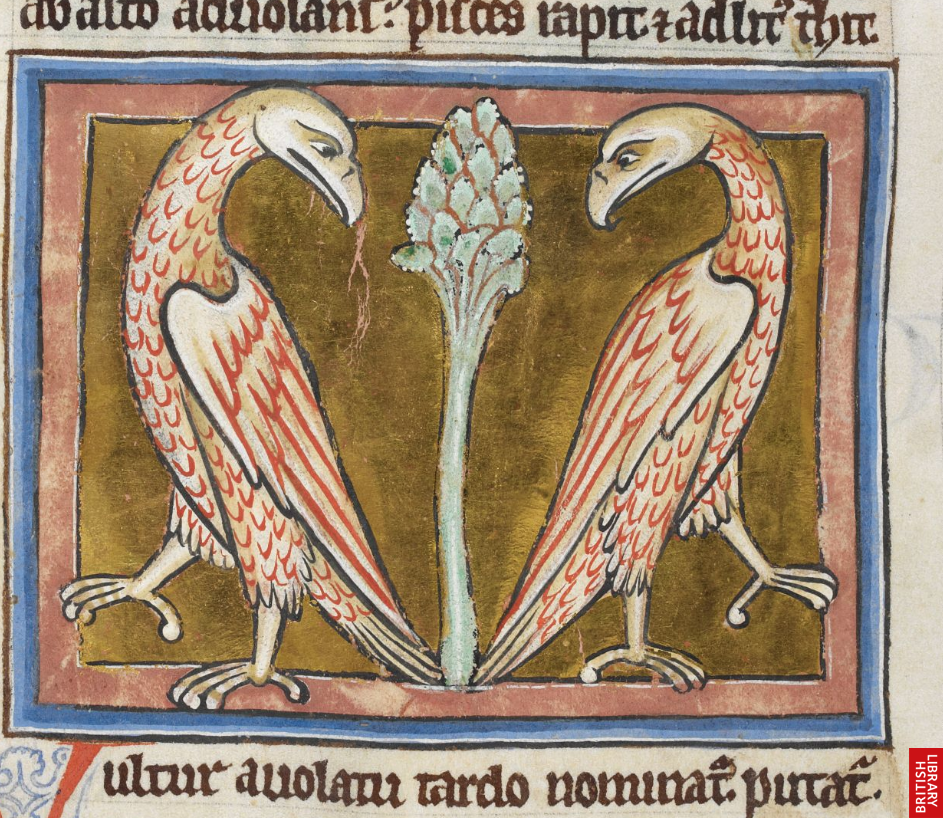
Vultures in a bestiary. Central or northern England, c. 1200-c. 1210. British Library, Royal MS 12 C XIX, fol. 38v. [bl.uk]
hlūd
hlūd, adj: loud, sonorous. (HLOOD / ˈhluːd)
cū-hyrde
cū-hyrde, m.n: a cowherd, person who has the charge of cows. (KOO-HUER-duh / ˈkuː-ˌhyr-də)
(Bonus word for today due to a Twitter tweet order mix-up!)
 Old English Wordhord