hēah-fæst, adj: very fixed (lit. “high-fast”). (HAY-ah-vast)
frēond-lēas
frēond-lēas, adj: friendless. (FRAY-ond-LAY-ahs)
It’s Goldgifa Week, which means some of the words are chosen by Wordhord patrons. Find out more on Patreon.
Goldgifa Avren Keating says, “I’ve heard there’s no word for ‘lonely’ in Old English and Middle English, is this true? I figure something like nabban-cynne could work?”
I’d never thought about this before, but I think that’s true of Old English. There are words like ān-floga (lone flier) and ān-stapa (lone wanderer), but I can’t think of an adjective that specifically means “lonely” or “loneliness”. I like the idea of nabban-cynne (or perhaps næbbende-cynne would be more grammatical?). I think the closest word that actually exists in extant Old English literature is frēond-lēas, friendless. Cynn-lēas would mean kin-less, but it doesn’t appear in extant literature so there’s no proof it was used.
Any thoughts on this?
Thanks, Avren, for the interesting question!
hearpestre
hearpestre, f.n: a female harper. (HAY-arp-est-reh)
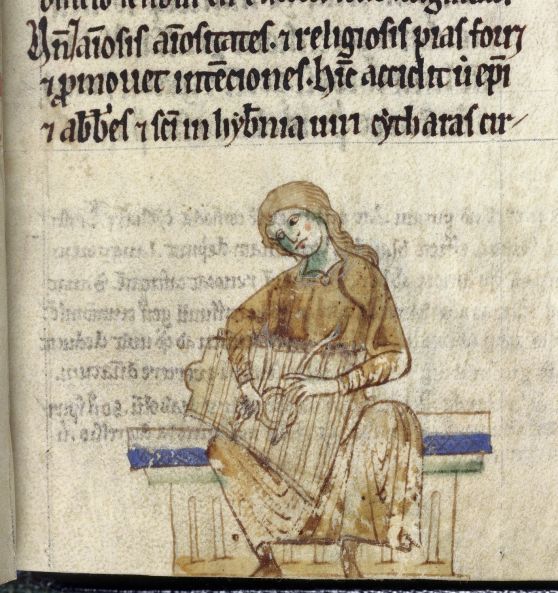
A woman playing a harp. Gerald of Wales’s Topographia Hiberniae. England, N. (Lincoln?), c. 1196-c. 1223. British Library, Royal 13 B VIII, f. 26r. [bl.uk]
hearpere
hearpere, m.n: a harper. (HAY-arp-eh-reh)
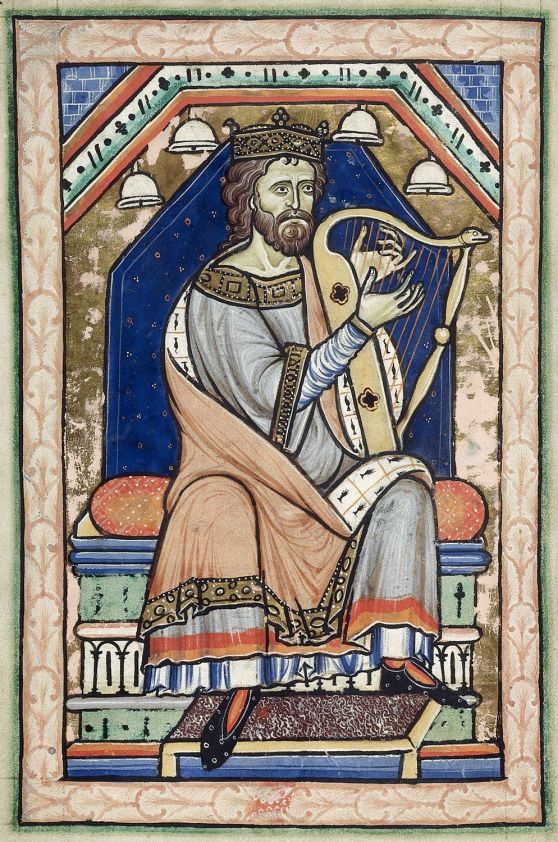
David playing the harp in the Westminster Psalter. S. England (Westminster or St Albans), c. 1200. British Library, Royal 2 A XXII, f. 14v. [bl.uk]
hlēoðrian
hlēoðrian, wk.v: to sound, make a sound (with the voice), to speak, sing, cry, exclaim, resound. (HLAY-oth-rih-yahn)
ciris-æppel
ciris-æppel, m.n: a cherry. (CHIR-iz-APP-ell)
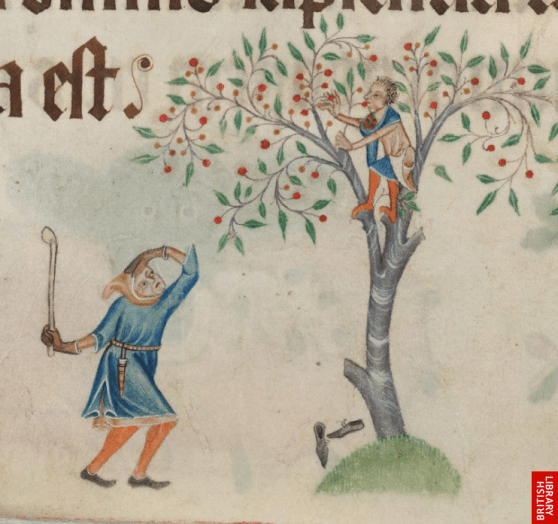
A boy stealing cherries from a tree. The Luttrell Psalter. Northern England (Lincolnshire), 1325-1340. British Library, Add MS 42130, f. 196v. [bl.uk]
ealo-wǣge
ealo-wǣge, n.n: ale-cup. (AY-ah-lo-WÆ-yeh)
This week’s Wordhord Wednesday post is about Judith, the clever, sword-wielding beauty who saved her people. Read it on Patreon.
ofer-mǣte
ofer-mǣte, adj: beyond measure, excessive, immoderate, immense. (OH-ver-MAT-eh)
mēowle
mēowle, f.n: a maid, damsel, virgin, woman. (MAY-oh-leh)
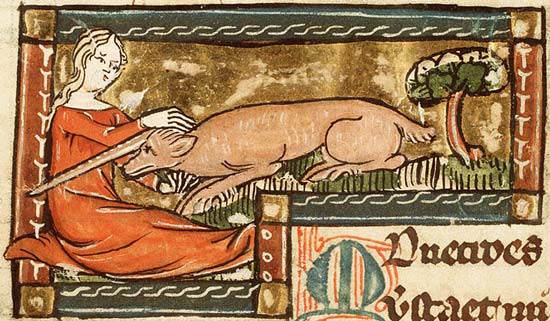
A unicorn resting its head in a maiden’s lap. Most depictions of this scenario have a hunter stabbing the poor unicorn but in this image we can imagine the two are simply good friends. Jacob van Maerlant’s Der Naturen Bloeme. Flanders, c. 1350. Hague, Koninklijke Bibliotheek, KB, KA 16, f. 63r. [bestiary.ca]
hār-wenge
hār-wenge, adj: hoary, grey-haired. (HAR-WENG-guh / ˈhaːɹ-ˌwɛŋ-gə)
 Old English Wordhord