Old English Wordhord

Old English Word of the Day

Navigation

Skip to content
  • About
  • Linktree
  • Books
    • The Wordhord: Daily Life in Old English
    • The Deorhord: An Old English Bestiary
    • Book Illustrations
  • App
  • Events
  • Podcasts
  • Merch
  • More content on Patreon
  • Goldgifa Page
  • Pronunciation
  • Not “Anglo-Saxon”
  • Medieval Resources

Category Archives: animals

Post navigation

← Older posts
Newer posts →

haswig-feþera

Posted on November 29, 2024 by Hana Videen

haswig-feþera, adj: having grey feathers; used as a substantive to mean ‘the grey-feathered one’. (HA-zwih-FETH-er-ah / ˈhaz-wɪj-ˌfɛ-θɛ-ra)

Posted in animals, colours, deorhord book Leave a comment

wæl-cēasiga

Posted on November 26, 2024 by Hana Videen

wæl-cēasiga, m.n: chooser of the slain (an epithet for the raven). (WAEL-CHAY-ah-zi-ga / ˈwæl-ˌtʃeːa-zɪ-ga)

Medieval manuscript image of a large-eyed raven in profile within a red roundel.
De avibus; France, early 13th century; Bibliothèque Nationale de France, lat. 2495, f. 14r. [bestiary.ca]
Posted in animals, battle, deorhord book Leave a comment

nīten-cynn

Posted on November 15, 2024 by Hana Videen

nīten-cynn, n.n: kind of animal. (NEE-ten-KUEN / ˈniː-tɛn-ˌkyn)
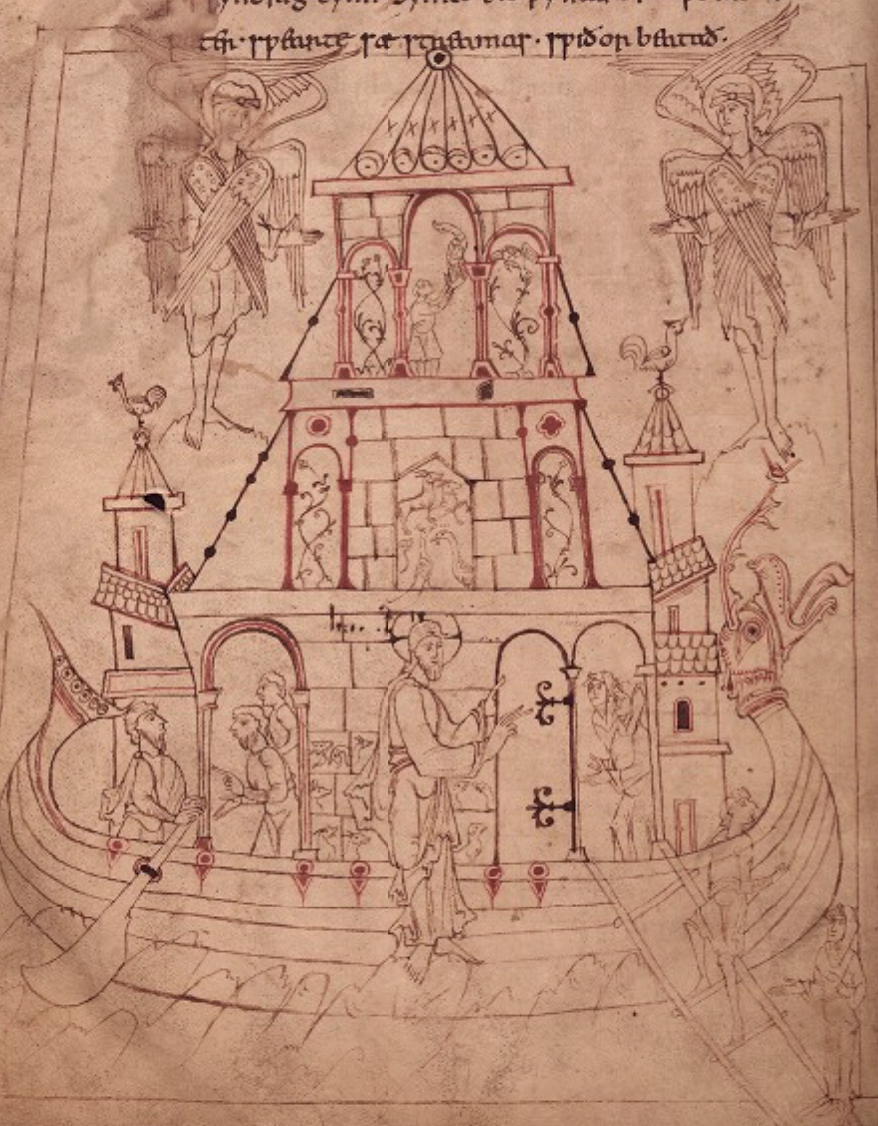
Medieval manuscript image of Noah’s Ark, a dragon-headed ship filled with people and a variety of different animals in a tower-like structure; two six-winged angels hover above.
Junius Manuscript; England, 1000; Bodleian Library, MS Junius 11, p. 66. [digital.bodleian.ox.ac.uk]
Posted in animals, deorhord book Leave a comment

lobbe

Posted on October 29, 2024 by Hana Videen

lobbe, f.n: spider. (LOB-buh / ˈlɔb-bə)

Medieval manuscript written in Latin with the words “de aranea marina” in red and an illustration of a round, black creature with eight squiggly legs.
Sea-spider from Liber de natura rerum; France (Abbaye de Saint-Amand), 13th century; Bibliothèque Municipale de Valenciennes, MS 320, f. 123v. [patrimonie-numerique.ville-valenciennes.fr]

Posted in animals, deorhord book Leave a comment

gūþ-hafoc

Posted on October 21, 2024 by Hana Videen

gūþ-hafoc, m.n: war-hawk (an epithet for the eagle). (GOOTH-HA-vock / ˈguːθ-ˌha-vɔk)

Medieval manuscript image of a multi-coloured eagle surrounded by crosses, with the words “imago aquilae” in red.
The Northumbrian Gospels; England, 8th century; Cambridge, Corpus Christi College, MS 197B, p. 245. [parker.stanford.edu]
Posted in animals, deorhord book Leave a comment

fola

Posted on October 1, 2024 by Hana Videen

fola, m.n: young animal (mainly equine but also the young of camels and elephants). (FOLL-ah / ˈfɔ-la)

Medieval manuscript image of two adult elephants facing one another, one of which stands in water with a baby elephant.
Bestiary; England, 13th century; Bodleian Library, MS. Douce 167, f. 10r. [digital.bodleian.ox.ac.uk]
Posted in animals, deorhord book Leave a comment

hwelp

Posted on September 24, 2024 by Hana Videen

hwelp, m.n: cub of a lion or bear; a young dog. (H’WELP / ˈhwɛlp)

Medieval manuscript image of a pair of male lions gently licking three lion cubs.
Northumberland Bestiary; England, c. 1250-60; J. Paul Getty Museum, Ms. 100, f. 8r. [blogs.getty.edu]
Posted in animals, deorhord book Leave a comment

hwilpa

Posted on September 16, 2024 by Hana Videen

hwilpa, m.n: bird, probably a curlew. (H’WILL-pa / ˈhwɪl-pa)

Posted in animals, deorhord book Leave a comment

fiþer-fōte

Posted on August 1, 2024 by Hana Videen

fiþer-fōte, adj: four-footed. (FITH-er-FOAT-uh / ˈfɪ-θɛr-ˌfoː-tə)

Medieval manuscript image of goats, cattle, long-horned sheep and camels.
Old English Hexateuch; England (Canterbury), 11th-12th century; British Library, Cotton MS Claudius B IV, f. 48v. [thijsporck.com]
Posted in animals, body + health, deorhord book Leave a comment

sǣ-fisca cynn

Posted on July 21, 2024 by Hana Videen

sǣ-fisca cynn, n: sea-fish-kind, any creature that lives in the sea. (SAE-FISK-ah KUEN / ˈsæː-ˌfɪ-ska ˈkyn)

Medieval manuscript image of a variety of fish against a gold background, including long eel-like creatures, one with horns like a goat, one that resembles a horse and another a dragon.
Ashmole Bestiary; England (Peterborough?), early 13th century; Bodleian Library, MS. Ashmole 1511, f. 86r. [digital.bodleian.ox.ac.uk]
Posted in animals, deorhord book Leave a comment

Post navigation

← Older posts
Newer posts →

Find Posts

Support

Become a Goldgifa to support my work and read additional content.

  • Patreon

Follow

  • Bluesky
  • Instagram
  • Facebook
  • Mastodon
Download on the App Store

Website Powered by WordPress.com.
  • Subscribe Subscribed
    • Old English Wordhord
    • Join 680 other subscribers
    • Already have a WordPress.com account? Log in now.
    • Old English Wordhord
    • Subscribe Subscribed
    • Sign up
    • Log in
    • Report this content
    • View site in Reader
    • Manage subscriptions
    • Collapse this bar
 

Loading Comments...