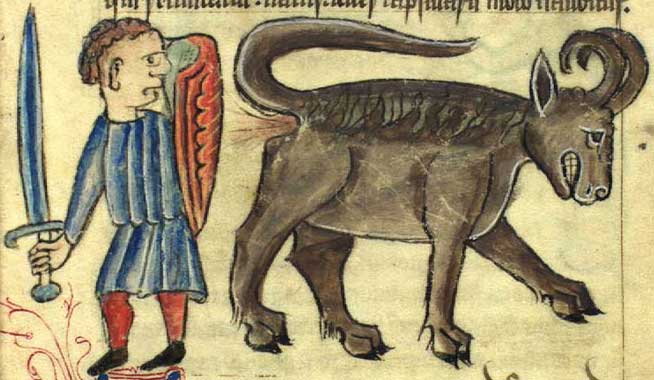
A bonnacon, which The Medieval Bestiary tells us is an animal like a bull that uses its dung as a weapon. Its horns curl in towards each other so are useless for defence. Pliny the Elder says ‘..when attacked, it runs away, while releasing a trail of dung that can cover three furlongs. Contact with the dung burns pursuers as though they had touched fire.’ Kongelige Bibliotek, Gl. kgl. S. 1633 4º, f. 10r.Bestiary of Ann Walsh. England, 15th century.
I expect it’s the same root. According to the infallible resource of Wikipedia, the bonnacon is also called bonacon or bonasus: https://en.wikipedia.org/wiki/Bonnacon.
I read that ‘bonnacon’ has also appeared in other manuscripts as “bannachus” and “bonacum” in the accusative. The double /nn/ of “bonnacum”, “bonnacon” is explained as being gemination, distinctive long consonants in Latin reflected in the orthography.
 Old English Wordhord
I don’t know what the etymology is for “bonnacon” but Ancient Greek “βόνασος” (bónasos) for the European bison (Latin: Bison bonasus) looks likely.
LikeLike
I expect it’s the same root. According to the infallible resource of Wikipedia, the bonnacon is also called bonacon or bonasus: https://en.wikipedia.org/wiki/Bonnacon.
LikeLike
I read that ‘bonnacon’ has also appeared in other manuscripts as “bannachus” and “bonacum” in the accusative. The double /nn/ of “bonnacum”, “bonnacon” is explained as being gemination, distinctive long consonants in Latin reflected in the orthography.
LikeLiked by 1 person
Pingback: Dung, demons, booze, and sex: Your favourite words in 2015 | Old English Wordhord
Pingback: wīg-gār | Old English Wordhord
Reblogged this on ReBirth: The Pursuit of Porsha.
LikeLike